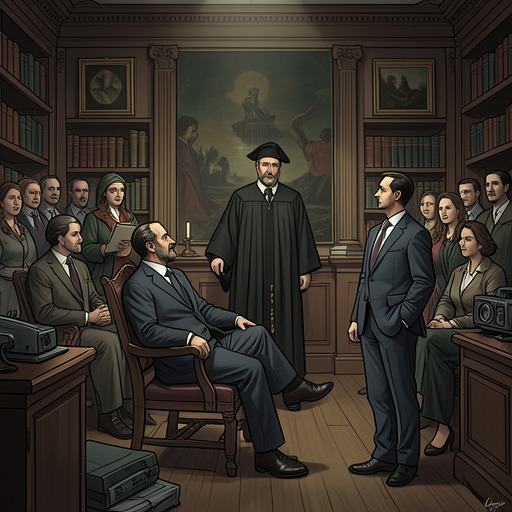
Milligan's Competency-to-Stand-Trial Hearing
The Minds of Billy MilliganBilly Milligan’s competency-to-stand-trial hearing separated a question about his present ability to face court from the distinct question of his mental state when the charged acts occurred. On October 6, 1978, Judge Jay Flowers ruled that Milligan was capable of standing trial, relying on an extensive hospital examination. The ruling moved the case toward trial, but it did not decide criminal responsibility for the earlier offenses or settle which version of Ohio law would govern the insanity defense.
Background and the first evaluation
In January 1978, Gary Schweickart and Judy Stevenson arranged for a psychological evaluation while continuing to represent Milligan despite his letter dismissing them. The Public Defender’s Office released funds for the assessment, and Dr. Willis C. Driscoll administered a battery of tests on January 8 and 13. The intelligence tests produced an IQ score of 68, which Driscoll said had been lowered by Milligan’s depression. He diagnosed acute schizophrenia and described severe difficulty distinguishing self from surroundings, experiences of voices, and an inability at that time to understand events well enough to assist in his defense. Driscoll recommended hospitalization for further examination and possible treatment.
On January 19, Schweickart and Stevenson presented Driscoll’s report to Judge Jay Flowers as evidence that their client could not assist in his own defense. Flowers directed the forensic psychiatry unit of Southwest Community Mental Health Center to examine Milligan. The defense worried that the center usually supported the prosecution, and Schweickart argued that anything Milligan disclosed in the examination should remain privileged. Prosecutors Terry Sherman and Bernie Yavitch objected; the dispute came close to a contempt finding. The eventual compromise allowed prosecutors to question Milligan about incriminating statements to the court-appointed clinicians only if he later took the stand. The defense accepted those terms and allowed the examination to proceed.
The hospital study and competency ruling
By October, the basis for the competency decision was no longer Driscoll’s short series of tests alone. Judge Flowers had before him Dr. George Harding’s report, produced after a hospital study of more than seven months and consultation with numerous psychologists and psychiatrists. Sherman and Yavitch considered the report unusually thorough, including because it addressed positions they might ordinarily have challenged in psychiatric testimony. After a brief competency hearing on October 6, Flowers ruled on the basis of that report that Milligan could stand trial and scheduled the trial for December 4.
The ruling concerned Milligan’s capacity at the time of the hearing to proceed through the criminal case; it was not a finding that he had been mentally well when the offenses occurred. Nor did the diagnosis, by itself, determine the legal outcome. The narrative keeps clinical assessments and legal standards distinct: the initial report described serious impairment and inability to assist, while the later hospital study supported a finding of present competency.
Public disclosure and the dispute over applicable law
The diagnosis had been kept from the public while treatment and the legal case proceeded. The defense feared that public attention would make it harder both to treat Milligan and to try the case. The prosecutors also agreed not to disclose the diagnosis before it had been presented in court. That privacy ended on September 27, when the Columbus Citizen-Journal broke the story. The newspaper disclosure preceded the competency hearing and changed the diagnosis from information held by clinicians and court participants into a public matter.
At the competency ruling, Schweickart accepted a trial date on one condition: that the case be tried under the law in effect when the crimes occurred. Ohio’s law was due to change on November 1, shifting the burden of proving insanity from the prosecution’s burden to prove sanity to a burden on the defendant to prove insanity. Yavitch disagreed with the defense’s position. Flowers took the question under advisement; the competency ruling itself therefore did not resolve which law would apply.
Separate findings at trial and afterward
The subsequent trial addressed the offenses and Milligan’s mental condition at the time they occurred. Judge Flowers dismissed the first rape count for lack of corroborating evidence and a similar pattern of conduct. On counts two through ten, the stipulated medical evidence stated that Milligan had been mentally ill during the offenses, could not distinguish right from wrong, and could not refrain from the acts. Flowers found him not guilty by reason of insanity on those counts. That later judgment answered a different legal question from the October competency decision: ability to stand trial in 1978 was not the same as responsibility for conduct at the time of the offenses.
A later court order further demonstrates how diagnosis and legal disposition remained connected but distinct. On December 10, 1979, the court found Milligan mentally ill, identified his condition as multiple personality, and ordered hospitalization at Lima State Hospital for treatment consistent with that diagnosis. The order cited risks to himself and others and the need for hospital treatment. Read alongside the competency ruling, the sequence shows how the case moved through separate judgments about present trial capacity, responsibility at the time of the offenses, and the treatment and security required afterward.